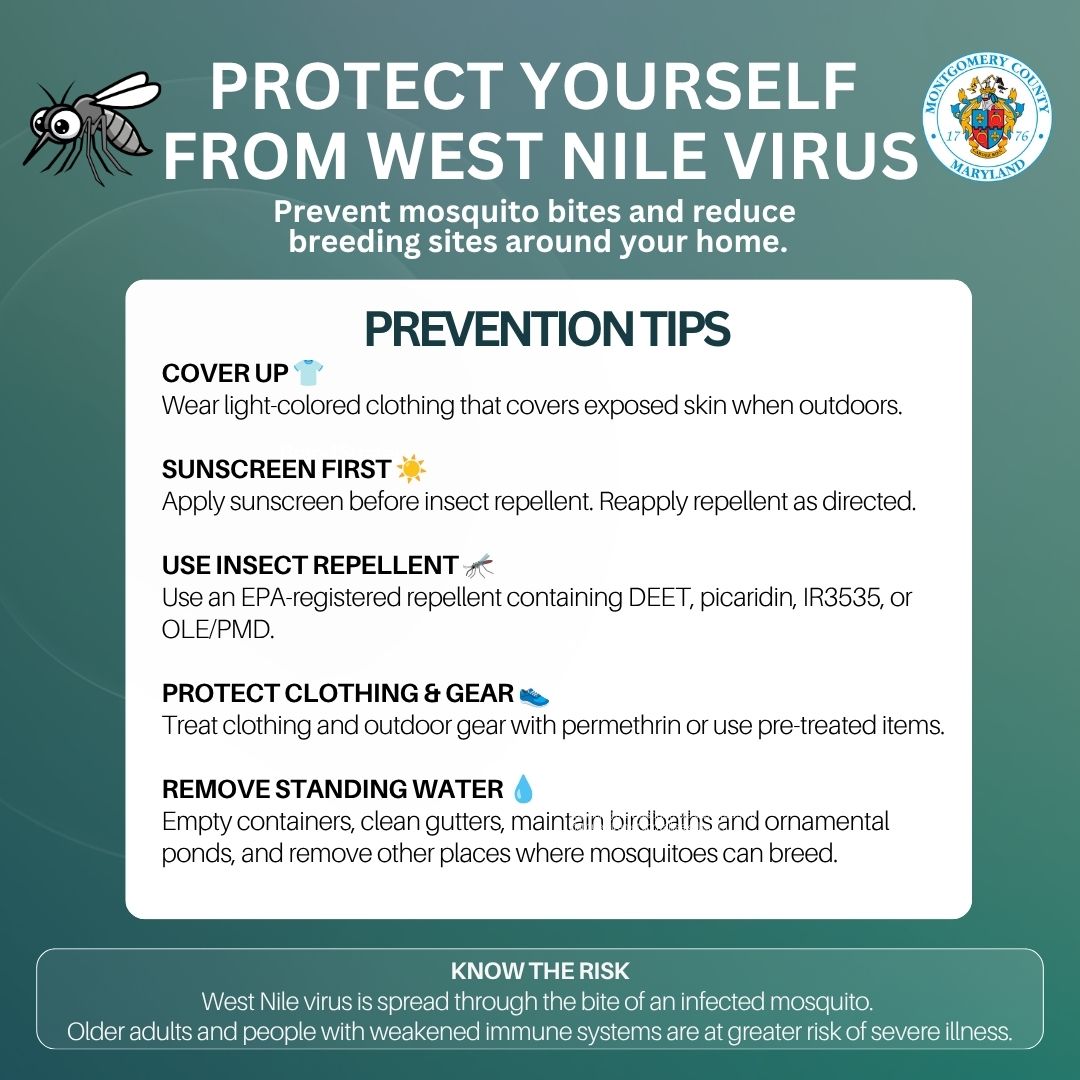
Montgomery County health officials are warning residents to take precautions against West Nile virus after Maryland confirmed its first human case of 2026.
The county government posted the alert Friday, Aug. 7, urging residents to eliminate standing water around their homes and protect themselves from mosquito bites. The Maryland Department of Health announced the case Aug. 2, according to WTOP, identifying the patient only as a "Capital Region resident" without disclosing which county.
The timing matters. August and September are historically the highest-risk months for West Nile transmission, and the 2026 season is running well ahead of pace nationally. CDC surveillance data showed 143 human cases through Aug. 4, roughly two and a half times the number reported at the same point in 2003, the year of the largest U.S. outbreak on record. That season ultimately produced 9,862 cases and 264 deaths. A more recent tally from the University of Minnesota's Center for Infectious Disease Research and Policy put the national count at 181 cases across 30 states.
"We are in the season when the West Nile virus and other mosquito-borne viruses can spread in Maryland," Dr. Meg Sullivan, deputy secretary for public health services at MDH, said when the state announced the case.
What residents should do
State health officials recommend using EPA-registered insect repellent and covering exposed skin when outdoors, particularly around dawn and dusk when mosquitoes are most active.
At home, MDH says even a discarded can or container holding a small amount of water can become a breeding ground. Clogged rain gutters and drain pipes are common culprits. The county is asking residents to walk their yards and eliminate any pooled water.
Who is most at risk
Most people infected with West Nile show no symptoms. Those who do may develop fever, headache, body aches, and occasionally a skin rash or swollen lymph glands. But individuals older than 50 or with compromised immune systems face a higher risk of serious illness.
There is no vaccine for West Nile virus in humans and no antiviral treatment.
Mosquitoes pick up the virus by feeding on infected birds. Residents who spot sick or injured birds can report them to a wildlife rehabilitator at 1-877-463-6497.
The Montgomery County Department of Health and Human Services can be reached at (240) 777-1050.