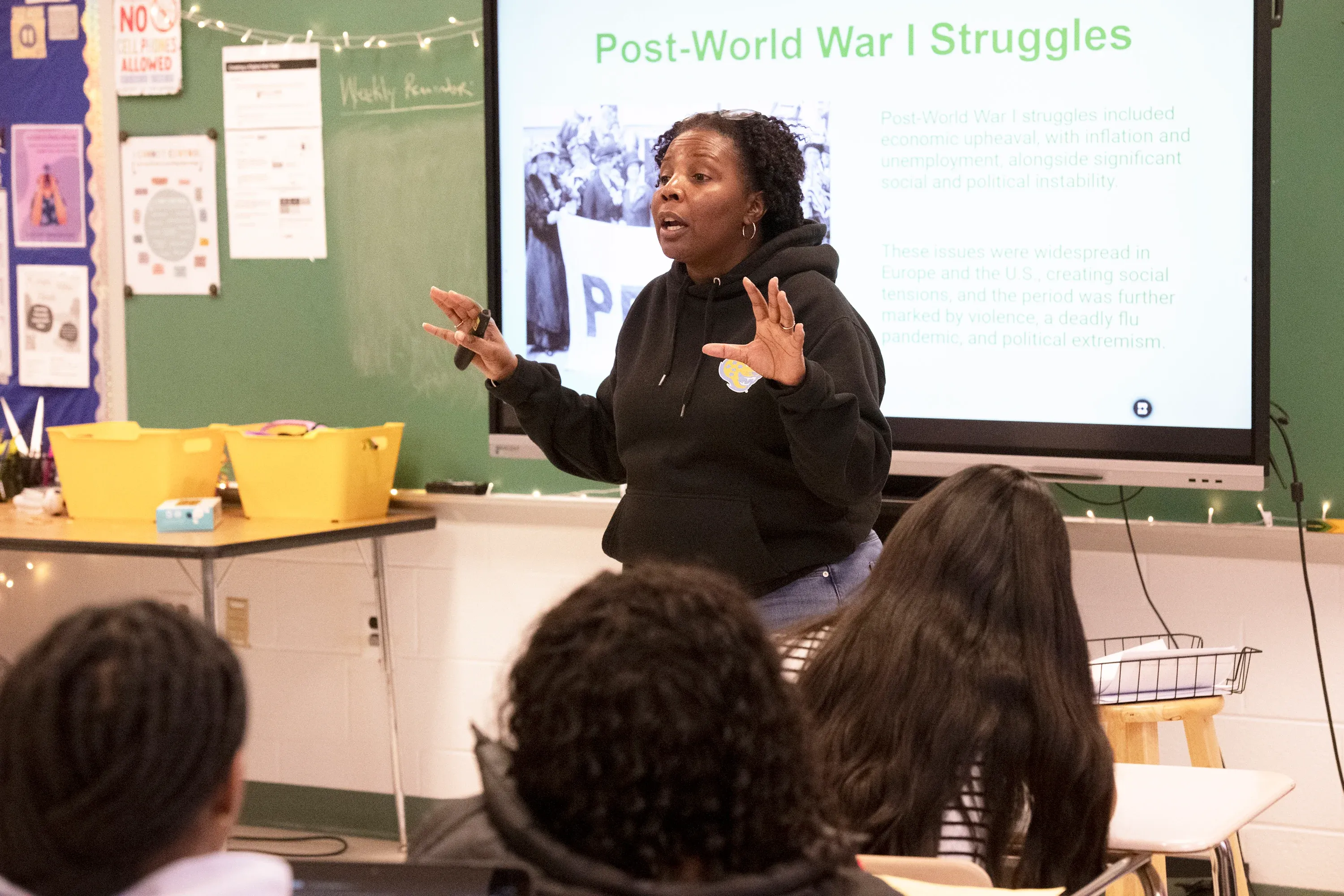
Montgomery County Public Schools students returned to class Tuesday, Aug. 25, facing a school year shaped by budget cuts, crumbling buildings and a new threat: potential federal funding reductions that Superintendent Thomas Taylor says would hit the district's most vulnerable kids hardest.
In a first-day interview with WTOP, Taylor said federal cuts risk undermining Title I equity programs, mental and behavioral health services, special education, English multilingual learner supports and after-school programming across the more than 150,000-student district.
Taylor said MCPS has "developed systems of care to prevent serious service impacts to our kids and families; however, this approach can't last forever and we will need a more sustainable approach in the future."
The federal funding pressure lands on top of an already strained local budget. The Montgomery County Council's $7.9 billion operating budget, adopted in May, left MCPS with a $36 million shortfall. The Board of Education voted 7-1 to close that gap by eliminating roughly 415 positions, including social workers, family engagement specialists and pupil personnel workers who provide direct support to families.
The largest cuts fell on special education, reduced by $13.7 million, and student personnel services, cut by $9 million. MCPS already has one school psychologist for every 1,100 students, more than double the nationally recommended caseload of one per 500, according to Washington Jewish Week reporting in July.
Bethesda schools feel the squeeze
Bethesda-Chevy Chase High School was among the MCPS buildings that closed temporarily in June due to high heat inside the building, a symptom of the district's $3 billion deferred maintenance backlog. The average MCPS school building is about 30 years old, and the district estimates it needs $560 million annually for routine capital replacement. It received $122.6 million for fiscal year 2027, according to Bethesda Magazine.
Taylor framed the infrastructure crisis as one of two critical challenges for the year, telling WTOP the "school system infrastructure is literally crumbling around us."
AI training and phone ban
Beyond budgets and buildings, MCPS rolled out two notable policy shifts for 2026-27. All staff completed mandatory AI literacy training before the school year began, and Taylor said the district issued guidance on managing screen time for its youngest students. A study on technology's classroom impact is underway.
A full-day cell phone ban for all students, including high schoolers, also took effect Tuesday under the Maryland Phone-Free School Act.
Test scores offer a bright spot
State assessment results released in late July showed modest gains: English proficiency rose to 58.5%, math to 36.9% and science to 40.1%, all above statewide averages. But racial achievement gaps persist. Just 50.1% of Black students and 36.2% of Latino students demonstrated ELA proficiency, compared with 81.9% of white students and 79.2% of Asian students.
Stacy Ganz Kahn, owner and founder of Educational Resources Group of Greater Washington, warned on July 30 that the budget cuts would ripple beyond special education. "It's not just special ed that's going to get cut, and remember too, when special ed gets cut, everything is going to be impacted because that means we're going to have less resources in the school, more relying on teachers, [and] they already do too much," she told Washington Jewish Week.
An elementary school boundary study launched in August will determine which schools may close or consolidate by the 2029-30 school year, with phase one ending in May 2027.

.webp)