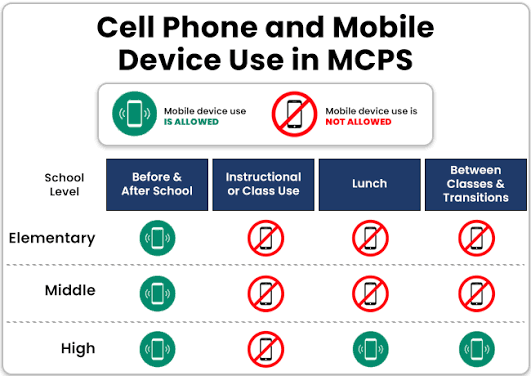
Two policies that will shape daily life for students at Bethesda-Chevy Chase, Walt Whitman and Walter Johnson high schools landed before the Montgomery County Council's Education and Culture Committee on Monday: how MCPS handles artificial intelligence in classrooms, and when students can use their phones.
The committee, chaired by Councilmember Will Jawando with members Shebra Evans and Kristin Mink, met at 9:30 a.m. in the Council Hearing Room in Rockville. The session was a review of existing district policies, not a vote. No formal action was taken.
Cell phones: current rules and a looming state deadline
Under MCPS Regulation COG-RA, last revised May 9, 2025, high school students may use personal devices during lunch and between classes but not during instruction. Elementary and middle school students must keep devices off and stored away all day. Principals can allow limited classroom use if it supports a lesson, and students with IEPs or 504 plans retain device access.
That framework faces a hard deadline. The Joanne C. Benson Maryland Phone-Free Schools Act, signed into law during the 2026 legislative session, requires every county school board to prohibit student use of electronic communication devices during the school day no later than the 2027-2028 school year.
Council staff asked MCPS what changes it plans in response, but the district had not provided that information as of Tuesday, according to the committee staff report prepared by Senior Legislative Analyst Doug Prouty and Legislative Analyst Kristin Cummings.
Bethesda parents flagged screen time concerns
A survey by the MCCPTA Technology Committee, conducted in November 2025 and collecting 1,003 responses by January 12, 2026, found that more than 70% of respondents said there was too much Chromebook use in class. Bethesda-Chevy Chase High School (29 responses out of 1,003 total) and Walter Johnson High School (25 responses) were among the top 10 schools by response volume.
On July 16, the Board of Education adopted a resolution directing MCPS to conduct a comprehensive review of student screen time and deliver a report by March 2027. That report must quantify average daily screen time for elementary and middle school students and recommend age-appropriate guidelines.
AI policy adopted in May
The Board of Education adopted Policy IGS, "Educational Technology," on May 21, 2026, after more than seven months of public comment. The policy covers eight areas including data privacy, equity, environmental concerns and the use of generative, predictive and agentic AI tools. It states that AI tools are meant to support and augment teacher-led instruction, not replace it, and advocates for screen-free time in elementary schools.
The review comes after Gov. Wes Moore signed Maryland's Artificial Intelligence Ready Schools Act (SB 720) on May 26, 2026, directing the state education department to develop guidance for AI use in K-12 classrooms. The Council's Technology Modernization capital budget for MCPS Chromebooks and instructional software stands at $16.9 million for fiscal year 2027, half of what the Board originally requested, according to the committee staff report.
What's next
Dr. Peter Moran, MCPS chief of the Division of School Leadership and Improvement, and Kimberly Fields, chief of the Division of Technology Services, were listed on the committee agenda to brief members. A recording of the session is expected on the Council's website.
The Phone-Free Schools Act requires compliance by the 2027-2028 school year. The Board's screen time report is due by March 2027.