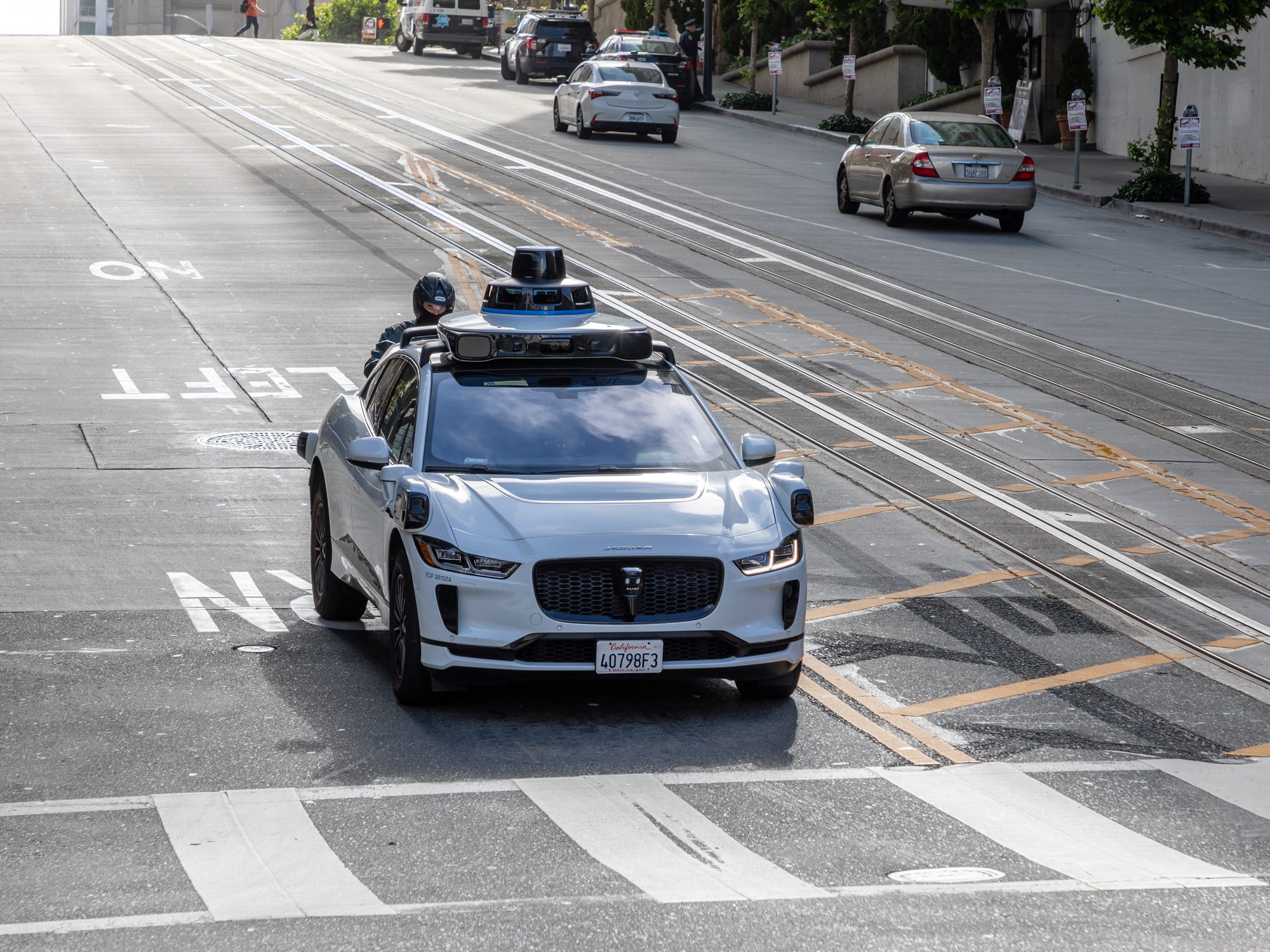
Waymo's driverless cars carry up to 29 external cameras that capture a continuous 360-degree view of everything around them. If those vehicles start rolling through Bethesda and Chevy Chase, they will record your front yard, your walk to the Metro and your kid's soccer practice without asking permission.
That prospect is getting closer. D.C. Council member Charles Allen announced the Autonomous Vehicle Deployment Authorization Amendment Act of 2026 on April 23, creating a path for commercial robotaxi service in the District. Maryland Gov. Wes Moore has promoted a partnership with Waymo, though the state legislature ended its session in April without advancing a regulatory framework. Waymo and Tesla have already been testing vehicles with drivers on D.C. streets for years, according to NBC Washington.
No vote has been scheduled on Allen's D.C. bill, WTOP reported.
What the cars record
According to Waymo's privacy FAQ, each autonomous vehicle carries cameras, microphones and sensors that act as the "eyes and ears" of its driving system. External cameras work in daylight and low-light conditions. External microphones detect emergency sirens. The company says it does not use facial recognition or biometric identification.
But Waymo does not disclose how many cameras are inside its vehicles, how long footage is retained or whether it has ever turned over recordings to federal law enforcement, WIRED reported in June 2025. Waymo's privacy policy acknowledges the company "may share certain data with law enforcement as needed to comply with legal requirements."
Waymo spokesperson Sandy Karp told WIRED the company's general policy is to challenge data requests that are overly broad or lack sound legal basis. She said Waymo puts limits on who can access data and how long it is retained. The company declined to provide specifics.
Police already use the footage
Arizona police departments in Mesa and Chandler have requested and used Waymo footage for criminal investigations since 2016, according to WIRED's reporting, which cited ABC 15 in Phoenix. As of 2023, Waymo had been issued at least nine search warrants in San Francisco and Arizona's Maricopa County, according to WIRED's account of Bloomberg reporting.
In one San Francisco case, an officer argued there was "probable cause" that Waymo vehicles driving near a crime scene had captured footage of a murder victim and possible suspects. Waymo complied and provided the footage, WIRED reported.
A San Francisco police training document obtained by Vice in May 2022 explicitly told officers that autonomous vehicles have footage that could "help with investigative leads," according to WIRED.
A parallel debate over plate readers
The surveillance question extends beyond robotaxis. Montgomery County Police expanded its network of automated license plate readers, known as ALPRs (Automated License Plate Readers), from 30 cameras to 860 between 2022 and 2025, according to a Maryland Daily Record analysis of state reports. Across 26 Maryland law enforcement agencies, those cameras logged at least 4.8 billion scans in 2025.
Maryland has no statewide limit on how long agencies can keep ALPR data unconnected to a crime. Retention policies vary by department, the Daily Record found. Some agencies delete data after 30 days; others keep it for up to a year.
Montgomery County Del. Sarah Wolek, who co-sponsored the state's anti-ICE data privacy bill, told the Daily Record she plans to introduce ALPR regulation in the upcoming legislative session. Del. Lorig Charkoudian, also a Montgomery County Democrat, said conversations on regulation are underway.
Arlington County’s board voted Sept. 15 to discontinue its Flock Safety technology and begin removing 41 cameras, including 26 license-plate readers and 15 other surveillance cameras., according to NBC Washington. Fairfax County's school system preemptively banned the cameras on school property.
Few guardrails for pedestrians
The gap that privacy advocates highlight is this: passengers in a Waymo agree to the company's terms of service, but pedestrians walking past the vehicles do not.
Matthew Cavedon, director of the Project on Criminal Justice at the Cato Institute, told The Wash that access to surveillance systems like ALPRs should be "treated like other significant intrusions on people's privacy." He said, "There needs to be limits on when this stuff is activated, how much is retained and who can access it."
At a July 13 D.C. Council hearing, Allen pressed Waymo executives on whether robotaxis track people walking down the street, Axios reported. David Margines, Waymo's director of product management, responded that the vehicles cannot "see through your clothes" but did not address broader tracking concerns, according to Axios.
Allen's D.C. bill would cap initial fleet size at 200 vehicles per operator until Jan. 1, 2028, and charge a $5 million nonrefundable permit fee plus $0.15 per vehicle mile traveled, according to Greater Greater Washington. The bill includes data-sharing and crash-reporting requirements. Whether its data provisions address footage of non-passengers is not clear from available reporting.
Maryland lawmakers have discussed additional ALPR regulations for the next session. The D.C. Council has not scheduled a vote on Allen's bill.